
- Home
- Reports Store
- Medical Devices
AI in Medical Imaging Market
Customise your request
Need this report to answer something it does not cover? Tell us the decision you are facing and we will scope the work — or point you to a study that already answers it.
info@cortexmeridian.com+971 56 483 5090Report Scope
| Report ID / SKU | CM-MD-0010 |
|---|---|
| Report Code | CM-MD-P1-1010 |
| Report Type | Market Analysis & Forecast |
| Base Year | 2025 |
| Historical Period | 2021–2025 |
| Forecast Period | 2026–2035 |
| Geographic Scope | Global |
| Global Coverage | Yes |
| Regions Covered | North America; Europe; Asia-Pacific; Latin America; Middle East & Africa |
| Countries Covered | US; Canada; Mexico; UK; Germany; France; Italy; Spain; Netherlands; Switzerland; China; India; Japan; South Korea; Australia; Brazil; Argentina; Saudi Arabia; UAE; South Africa (20 countries) |
| Market Size Unit | USD Billion |
| Volume Unit | Software Licenses / Algorithms / Imaging Studies |
| Report Format | PPT / WORD / EXCEL / PDF |
| Page Count | 180-220 |
| Delivery Timeline | 48 hours |
| Sample Available | Yes |
| Author / Analyst | Cortex Meridian Medical Devices Analyst Team |
| Publish Date | October 2026 |
| Last Updated | 2026-10-06 |
Market Overview & Definition
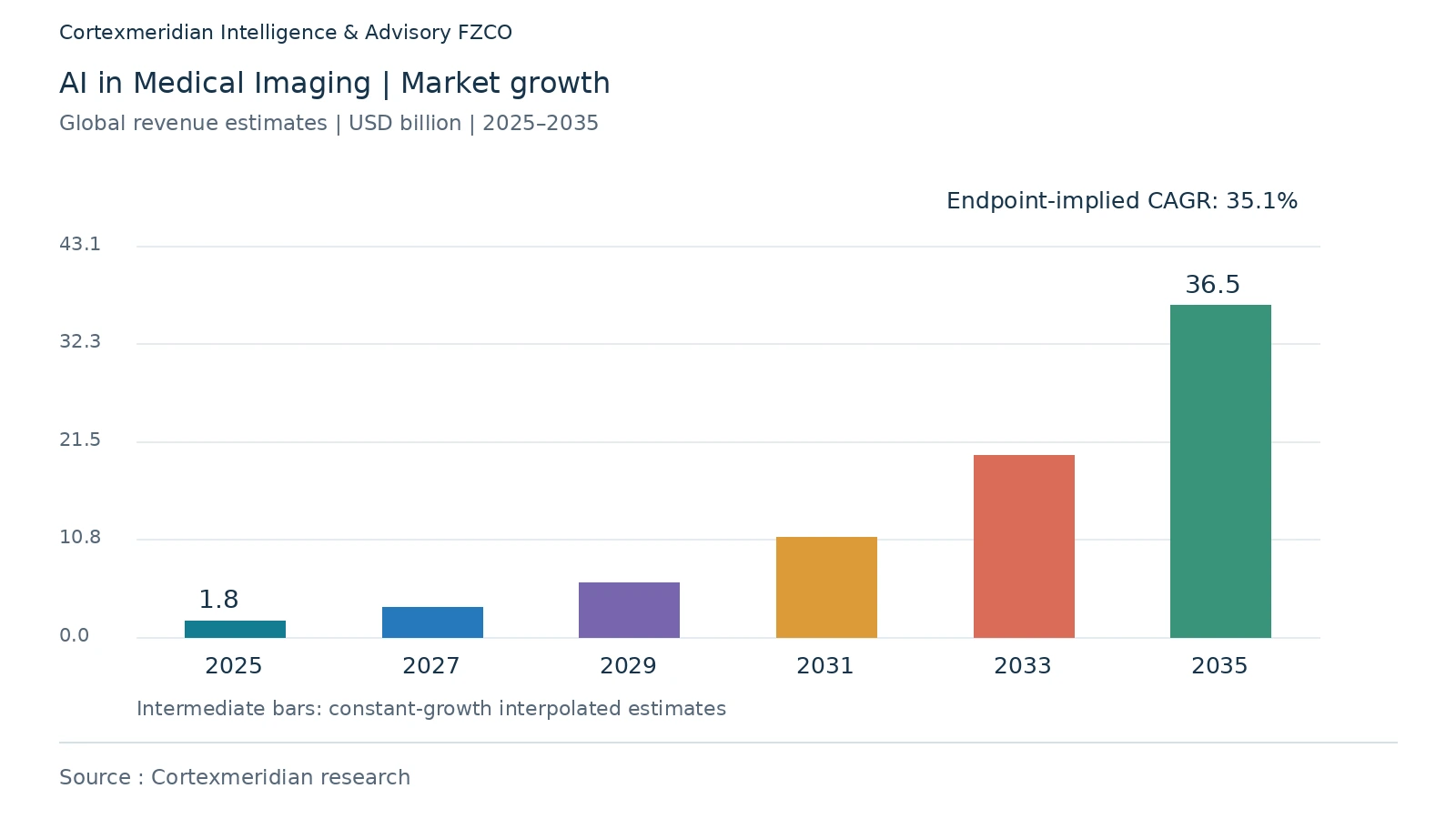
Cortex Meridian Research estimates the AI in Medical Imaging market at USD 1.8 billion in 2025 and projects it to reach approximately USD 36.5 billion by 2035, corresponding to a CAGR of 35.1%. The market is starting from a relatively small base, which explains the high growth rate, but the more important change is commercial: hospitals are moving from pilot use of single algorithms toward enterprise-wide AI orchestration, workflow integration and embedded OEM functionality.
The strongest use cases are those that reduce reporting burden, accelerate triage, improve image reconstruction or identify clinically actionable findings without adding workflow complexity. That makes integration with PACS, RIS and scanner platforms critical. Stand-alone algorithms may demonstrate clinical value, but enterprise purchasing is increasingly favoring platforms that can deploy, monitor and govern multiple AI applications at scale.
GE HealthCare’s Intelerad acquisition materially strengthens this enterprise model by combining cloud imaging infrastructure with AI orchestration. Its planned icometrix acquisition adds neurological MRI analytics, while the NVIDIA collaboration pushes AI deeper into autonomous acquisition and reconstruction. Aidoc’s USD 150 million funding round highlights investor confidence in enterprise clinical AI rather than single-use algorithms. These developments support the exceptional growth outlook because they improve distribution, interoperability and recurring subscription economics—three conditions required for AI to move from experimentation into routine deployment.
Report Description
The AI in Medical Imaging Market covers revenue generated from the defined medical-device products, related consumables and software/services where directly attached to the device workflow. The report excludes unrelated pharmaceuticals and stand-alone healthcare services. The scope is designed for manufacturers, suppliers, distributors, hospitals, diagnostic providers, investors and strategy teams evaluating demand, technology shifts, pricing and competitive opportunity.
Overall Market Dynamics
Drivers
Imaging-volume growth, radiologist shortages, demand for faster interpretation, workflow automation and improved diagnostic consistency.
Restraints / Risks
Regulatory approval, reimbursement uncertainty, algorithm bias, interoperability, cybersecurity and evidence requirements for clinical value.
Opportunities
Workflow orchestration, multimodal AI, autonomous triage, image reconstruction, opportunistic screening, cloud deployment and OEM embedding.
Strategic themes
AI/connectivity, workflow efficiency, reimbursement, regulatory approvals, recurring consumables/service revenue, and regional access expansion.
Segmentation & Scope
By technology: deep learning, machine learning, NLP/computer vision; by modality: CT, X-ray, MRI, ultrasound, mammography, nuclear imaging; by application: neurology, oncology, cardiology, orthopedics; by deployment: on-premise, cloud; by end user and geography.
Regional & Country Outlook
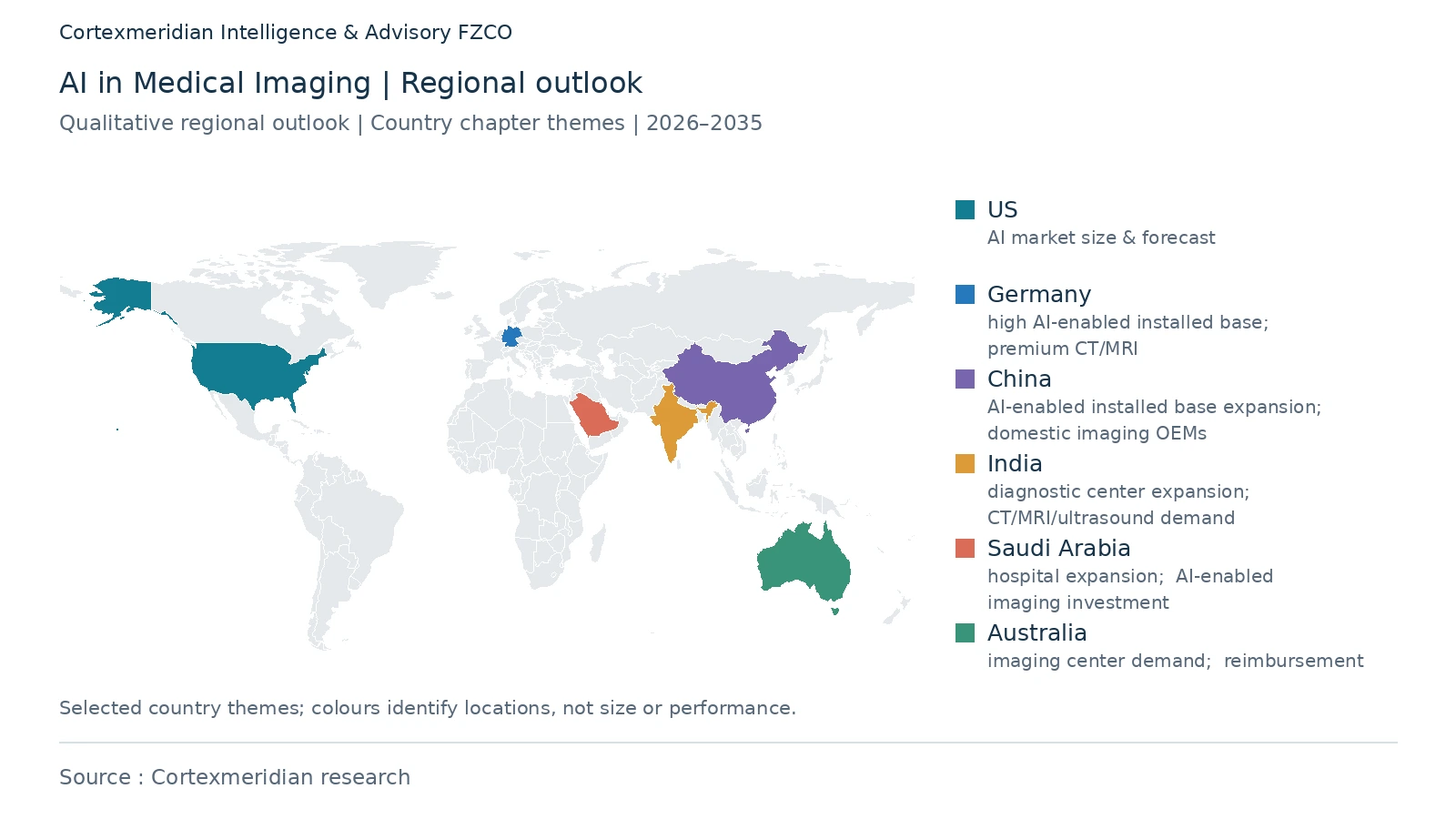
COUNTRY CHAPTER COVERAGE 1. US: AI market size & forecast; AI-enabled installed base and enterprise AI deployment; AI adoption across CT/MRI/X-ray/ultrasound; reimbursement; AI/cloud adoption; GE/Siemens/Philips/Canon competition. 2. Canada: AI-enabled installed base; provincial capital budgets; imaging wait times; MRI/CT expansion; cloud imaging; procurement. 3. UK: NHS imaging capacity; scanner replacement; diagnostic backlogs; community diagnostics; AI adoption; procurement. 4. Germany: high AI-enabled installed base; premium CT/MRI; enterprise AI deployments; reimbursement; hospital digitization. 5. France: hospital imaging investment; CT/MRI/ultrasound; reimbursement; teleradiology; procurement. 6. Italy: regional imaging infrastructure; replacement demand; CT/MRI; public/private mix. 7. Spain: public hospital imaging; enterprise AI deployment; CT/MRI/ultrasound; procurement. 8. Netherlands: enterprise imaging; cloud PACS; advanced MRI/CT; AI workflow; teleradiology. 9. Switzerland: premium imaging systems; private/public hospitals; MRI/CT; AI-enabled workflows. 10. China: AI-enabled installed base expansion; domestic imaging OEMs; localization; CT/MRI demand; procurement/pricing. 11. India: diagnostic center expansion; CT/MRI/ultrasound demand; price tiers; local manufacturing; private chains. 12. Japan: aging-driven imaging demand; CT/MRI density; reimbursement; domestic OEMs; enterprise AI deployment. 13. South Korea: advanced imaging; high CT/MRI utilization; AI imaging; hospital digitization. 14. Australia: imaging center demand; reimbursement; remote radiology; CT/MRI/ultrasound replacement. 15. Brazil: private imaging chains; public access; import pricing; CT/MRI/ultrasound; distributor market. 16. Argentina: imaging AI-enabled installed base; import dependency; pricing; private hospital demand. 17. Saudi Arabia: hospital expansion; AI-enabled imaging investment; localization; AI/cloud adoption; tenders. 18. UAE: premium imaging centers; private hospitals; advanced MRI/CT; AI and cloud adoption. 19. South Africa: public/private imaging gap; CT/MRI access; replacement needs; distributor structure.
Competitive Landscape & Companies Covered
GE HealthCare; Siemens Healthineers; Philips; Canon Medical; Microsoft; Viz.ai; HeartFlow; Tempus; Aidoc; Enlitic; Nanox.AI; Butterfly Network; EchoNous
Pricing & Ecosystem
Pricing, Cost & Revenue Intelligence
Pricing intelligence benchmarks capital-system ASPs, disposable/consumable pricing, procedure-linked device pricing, service contracts, software subscriptions and regional tender dynamics where applicable. The model distinguishes capital equipment from recurring revenue and evaluates discounting, bundling, distributor margins, reimbursement sensitivity and premium technology price realization.
Value Chain & Ecosystem Analysis
The ecosystem maps component and sensor suppliers, materials vendors, device OEMs, software/AI partners, contract manufacturers, sterilization and packaging providers, distributors, hospitals/diagnostic laboratories/ASCs, clinicians, payers and regulators. The analysis identifies control points in the value chain, recurring-revenue pools, channel dependencies and partnership opportunities.
Opportunity & White-Space Analysis
A weighted opportunity model scores product segments, technologies, countries, end users and accounts using growth, market size, clinical adoption, reimbursement, competitive intensity, regulatory accessibility and margin potential. Priority white spaces include Workflow orchestration, multimodal AI, autonomous triage, image reconstruction, opportunistic screening, cloud deployment and OEM embedding.
Executive Summary
The AI in Medical Imaging market is estimated at USD 1.8 billion in 2025 and is projected to reach approximately USD 36.5 billion by 2035 at a CAGR of 35.1%. The high growth rate reflects both a small starting base and a shift from isolated algorithms toward enterprise AI platforms embedded into radiology workflows.
GE HealthCare’s Intelerad acquisition, its planned icometrix transaction and expanded NVIDIA collaboration show how major imaging vendors are building integrated AI ecosystems rather than buying stand-alone algorithms. Aidoc’s USD 150 million funding round reinforces the same trend from the specialist side. The winners are likely to be platforms that can demonstrate clinical value while solving deployment, interoperability and governance challenges at scale.
Key Takeaways
- 2025 Cortex normalized estimate: USD 1.8 billion
- 2035 normalized outlook: USD 36.5 billion
- Normalized 2025–2035 CAGR: 35.1%
- Key growth drivers: Imaging-volume growth, radiologist shortages, demand for faster interpretation, workflow automation and improved diagnostic consistency.
- Priority opportunity areas: Workflow orchestration, multimodal AI, autonomous triage, image reconstruction, opportunistic screening, cloud deployment and OEM embedding.
- Primary competitive set: GE HealthCare; Siemens Healthineers; Philips; Canon Medical; Microsoft; Viz.ai; HeartFlow; Tempus; Aidoc; Enlitic; Nanox.AI; Butterfly Network; EchoNous
Table of Contents
List of Tables
- Global market value, 2021–2035
- Market by product/device type
- Market by technology
- Market by application/procedure
- Market by end user
- Market by region
- Country market sizing
- Installed base/procedure/test indicators
- ASP/pricing benchmark
- Company/product benchmark
- Opportunity attractiveness scoring
List of Figures
- Market size and CAGR outlook
- Segment attractiveness matrix
- Technology adoption curve
- Regional opportunity heat map
- Competitive positioning matrix
- Value-chain ecosystem map
- Pricing/revenue model
- Opportunity prioritization matrix
Research Methodology
Methodology
Cortex Meridian Research applies a triangulated market-sizing framework combining company disclosures, regulatory databases, procedure/test volumes, installed-base indicators, shipment and utilization data, hospital and laboratory purchasing patterns, reimbursement signals, product approvals, and primary research. Public market benchmarks are used only as external calibration points; Cortex values are normalized to the defined scope and forecast period. Forecasts consider technology adoption, procedure/test growth, replacement cycles, pricing, reimbursement, regulatory changes, and regional healthcare investment.
Data Sources & Validation
Company annual reports and investor materials; FDA, EMA and other regulatory databases; WHO and national health agencies; peer-reviewed clinical literature; procurement and reimbursement sources; hospital/laboratory statistics; trade and shipment indicators; company product portfolios; primary interviews; and public market benchmarks used for calibration.
FAQ — Buyer Questions
Q: What is the 2025 global AI in Medical Imaging market size? A: Cortex Meridian Research estimates it at approximately USD 1.8 billion.
Q: What is the 2035 market outlook? A: The normalized outlook is approximately USD 36.5 billion, based on a 35.1% CAGR assumption.
Q: What are the major growth drivers? A: Imaging-volume growth, radiologist shortages, demand for faster interpretation, workflow automation and improved diagnostic consistency.
Q: Which opportunities should suppliers prioritize? A: Workflow orchestration, multimodal AI, autonomous triage, image reconstruction, opportunistic screening, cloud deployment and OEM embedding.
Customization Options
Customization can include country-level sizing, procedure/test volumes, installed base, ASP benchmarking, hospital/lab account mapping, competitor benchmarking, product pipeline analysis, regulatory and reimbursement tracking, KOL mapping, distributor/channel assessment, and opportunity prioritization.
Need something this report does not cover?
Describe the decision you are facing. If a published study already answers it we will point you there; if not, we will scope the work and come back with timeline and cost.
CM-MD-0010 · CM-MD-P1-1010 · 180-220 pages · Published October 2026 · Cortex Meridian Medical Devices Analyst Team