
- Home
- Reports Store
- Digital Agriculture
Farm Management Software Market, Growth, Technology, Competitive Landscape & Forecast 2026–2035
Customise your request
Need this report to answer something it does not cover? Tell us the decision you are facing and we will scope the work — or point you to a study that already answers it.
info@cortexmeridian.com+971 56 483 5090Report Scope
| Report ID / SKU | CM-AG-0023 |
|---|---|
| Report Code | CM-AG-DA-1123 |
| Report Type | Market Analysis & Forecast |
| Base Year | 2025 |
| Historical Period | 2021–2025 |
| Forecast Period | 2026–2035 |
| Geographic Scope | Global |
| Global Coverage | Yes |
| Regions Covered | North America; Europe; Asia-Pacific; Latin America; Middle East & Africa |
| Countries Covered | US; Canada; UK; Germany; France; Italy; Spain; Netherlands; Switzerland; China; India; Japan; South Korea; Australia; Brazil; Argentina; Saudi Arabia; UAE; South Africa; Qatar; Oman; Kuwait; Bahrain; Egypt; Türkiye (25 countries) |
| Market Size Unit | USD Million |
| Volume Unit | Software Users / Farms |
| Report Format | PDF + Excel |
| Page Count | 180–240 |
| Delivery Timeline | 24–48 hours |
| Sample Available | Yes |
| Author / Analyst | Cortex Meridian Agriculture & Food Technology Research Team |
| Publish Date | October 2026 |
| Last Updated | 2026-10-07 |
Market Overview & Definition
Cortex Meridian Research values the Farm Management Software Market at USD 3.95 billion in 2025 and forecasts the market to reach USD 17.00 billion by 2035, representing a 2025–2035 CAGR of 15.7%. For this study, the market is defined around paid demand for crop planning, field operations, inventory, labor, finance, compliance, traceability and analytics software; revenue from adjacent agricultural output is excluded unless it forms part of the stated commercial offering. The demand model follows commercial farms, agribusiness groups, cooperatives and multi-site agricultural operators and separates new installations or capacity additions from replacement, retrofit, software/service and recurring input revenue. The market boundary is particularly important because published estimates often diverge when hardware, services, production value or infrastructure are combined differently. Cortex Meridian applies one consistent revenue boundary across 2021–2035 and evaluates the global opportunity against the operating variable that matters most to buyers: software earns renewal when it reduces admin effort, improves resource planning or creates a reliable management/control layer. The model also explicitly tests manual data entry, weak integrations and poor fit with existing field workflows so the forecast does not overstate adoption where technical availability is ahead of commercial readiness.
Report Description
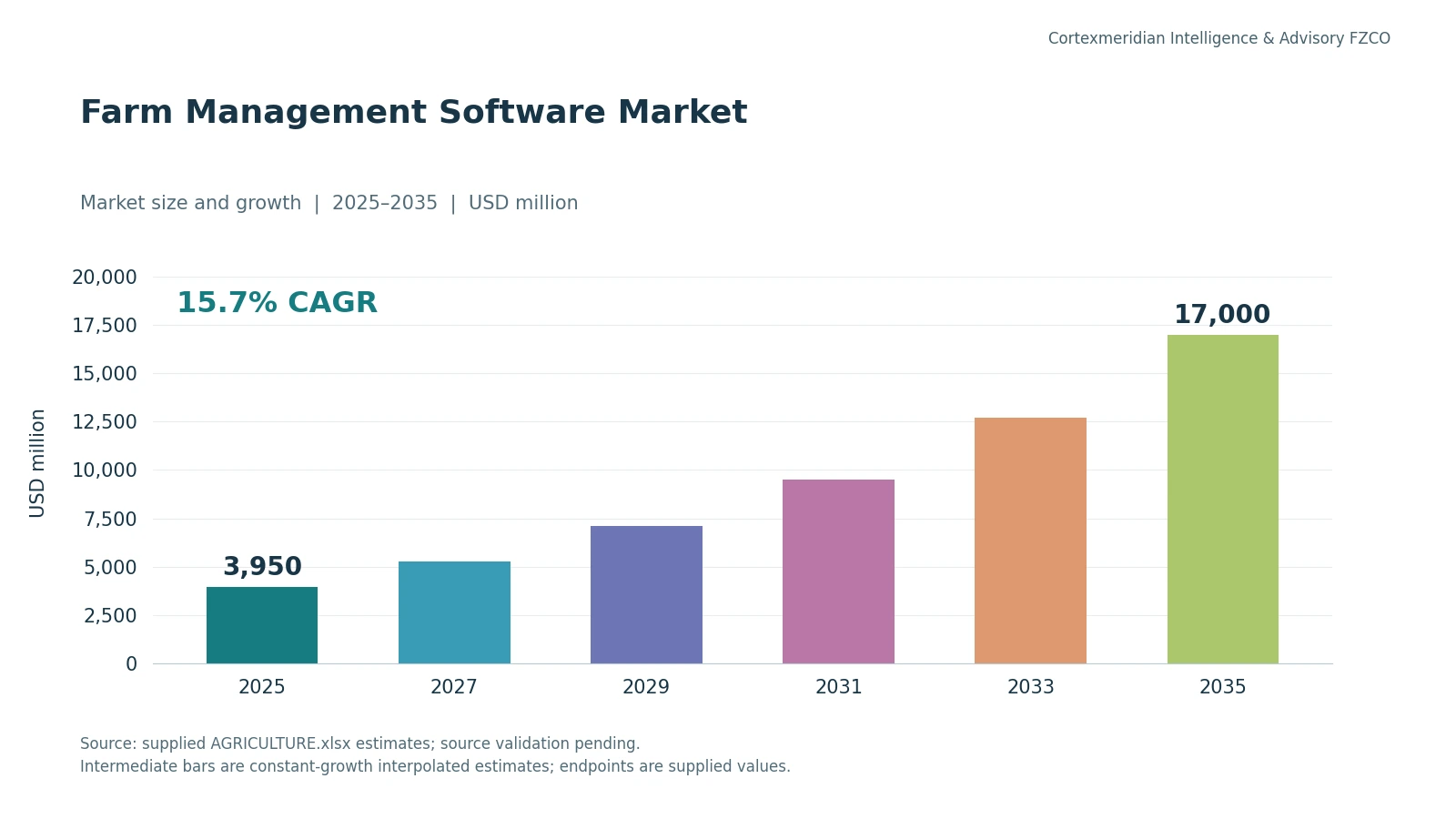
Cortex Meridian Research values the Farm Management Software Market at USD 3.95 billion in 2025 and forecasts the market to reach USD 17.00 billion by 2035, representing a 2025–2035 CAGR of 15.7%. The commercial structure of this market is centered on crop planning, field operations, inventory, labor, finance, compliance, traceability and analytics software. Demand is generated primarily by commercial farms, agribusiness groups, cooperatives and multi-site agricultural operators, and purchasing decisions are increasingly tied to software earns renewal when it reduces admin effort, improves resource planning or creates a reliable management/control layer rather than to technology adoption for its own sake. A major constraint on scalable adoption is manual data entry, weak integrations and poor fit with existing field workflows. This changes the basis of competition: specialist farm platforms compete with broader ERP, input-company and machinery ecosystems seeking to own farm data. Technology development is moving toward mobile-first workflows, API connectivity, AI assistants, embedded finance and automated data capture from equipment/sensors, which is shifting value from one-time equipment or product sales toward integrated systems, software, services, maintenance and recurring input revenue where applicable. In the global market context, large food-security projects need multi-site, multilingual and centralized-control capability rather than simple farm bookkeeping. The report therefore evaluates not only market growth, but also the quality of that growth—where customers can demonstrate payback, which segments have repeatable operating economics, which countries have executable project pipelines, and where suppliers can create a defensible position through local integration, service, data or channel access.
Overall Market Dynamics
Demand Formation
Demand originates mainly from commercial farms, agribusiness groups, cooperatives and multi-site agricultural operators. Purchase timing is driven by the ability to improve software earns renewal when it reduces admin effort, improves resource planning or creates a reliable management/control layer and by the availability of bankable local references.
Technology Shift
The market is moving toward mobile-first workflows, API connectivity, AI assistants, embedded finance and automated data capture from equipment/sensors. This changes the competitive basis from selling a stand-alone product toward integrating technology into the customer's operating workflow.
Adoption Friction
The largest practical constraint is manual data entry, weak integrations and poor fit with existing field workflows. The forecast therefore discounts deployments where the business case depends on ideal operating conditions or weakly supported pilot assumptions.
Competitive Implication
Specialist farm platforms compete with broader ERP, input-company and machinery ecosystems seeking to own farm data. Suppliers with local service, data integration and application know-how are better positioned to retain customers after the initial sale.
Geographic Implication
Large food-security projects need multi-site, multilingual and centralized-control capability rather than simple farm bookkeeping.
Segmentation & Scope
Segmentation will be tailored to Farm Management Software Market and organized across: technology/product type; system architecture; offering (hardware, software, services, consumables where relevant); farm/production scale; application/crop/species; deployment model; customer type; sales channel; and geography. For Farm Software/Farm ERP, Analytics & Decision Support, the RD will explicitly separate mature revenue pools from emerging technologies, installed-base/retrofit demand from greenfield projects, and one-time equipment sales from recurring service/software/input revenue.
Regional & Country Outlook
global outlook: country attractiveness is assessed against the actual operating variables that matter for Farm Management Software Market: customer concentration, project pipeline, input/resource economics, infrastructure, policy support, channel depth and serviceability. The regional lens is not a generic country ranking. It tests where software earns renewal when it reduces admin effort, improves resource planning or creates a reliable management/control layer are most favorable and where manual data entry, weak integrations and poor fit with existing field workflows is least restrictive. For Middle East/GCC markets, Saudi Arabia and the UAE are examined for active projects, buyer organizations, procurement structure and local integration capability; other covered countries are assessed where their production base or technology ecosystem is material. For global titles, North America, Europe, Asia-Pacific, Latin America and Middle East & Africa are compared on adoption maturity, unit economics and supplier concentration.
Competitive Landscape & Companies Covered
The competitive landscape is organized around the ability to deliver crop planning, field operations, inventory, labor, finance, compliance, traceability and analytics software with demonstrable operating results. Specialist farm platforms compete with broader ERP, input-company and machinery ecosystems seeking to own farm data. Company benchmarking therefore covers product breadth, installed base/reference projects, integration capability, recurring revenue mix, channel model, local service footprint and evidence of customer-level performance. Emerging companies are screened specifically for mobile-first workflows, API connectivity, AI assistants, embedded finance and automated data capture from equipment/sensors, while incumbents are assessed for whether they are building these capabilities internally, through partnerships or through acquisition.
Pricing & Ecosystem
Pricing, Cost & Revenue Intelligence
Pricing is assessed against the unit that the buyer ultimately manages economically. For this market, the relevant value case is software earns renewal when it reduces admin effort, improves resource planning or creates a reliable management/control layer. The report distinguishes upfront equipment/project pricing from software subscriptions, consumables, service, maintenance and performance-linked revenue where applicable. Cost analysis tests the variables that can overturn the purchase case—especially those embedded in manual data entry, weak integrations and poor fit with existing field workflows. Where regional operating conditions materially alter payback, the report presents separate sensitivity logic rather than applying a single global ASP or ROI assumption.
Value Chain & Ecosystem Analysis
The ecosystem starts with the suppliers of the core technologies and inputs behind crop planning, field operations, inventory, labor, finance, compliance, traceability and analytics software, then follows integrators/distributors into commercial farms, agribusiness groups, cooperatives and multi-site agricultural operators. The analysis identifies who specifies the solution, who signs the purchase order, who services the installed base and who controls the recurring customer relationship. Particular attention is given to the point where technical performance becomes commercial value through software earns renewal when it reduces admin effort, improves resource planning or creates a reliable management/control layer. Bottlenecks such as manual data entry, weak integrations and poor fit with existing field workflows are mapped to the ecosystem participant best placed to solve them, revealing partnership and margin-pool opportunities.
Opportunity & White-Space Analysis
White-space is defined as an unmet commercial need rather than a high-growth segment alone. The strongest opportunities are where mobile-first workflows, API connectivity, AI assistants, embedded finance and automated data capture from equipment/sensors can materially improve software earns renewal when it reduces admin effort, improves resource planning or creates a reliable management/control layer and where existing suppliers have not fully solved manual data entry, weak integrations and poor fit with existing field workflows. The report ranks opportunities by buyer urgency, technical readiness, addressable account base, channel accessibility, local service requirement and recurring-revenue potential. For global markets, the analysis also tests whether localization, integration or operating support can create a defensible position even when the core hardware is globally available.
Executive Summary
Farm Management Software Market — Executive Summary
Cortex Meridian Research values the Farm Management Software Market at USD 3.95 billion in 2025 and forecasts the market to reach USD 17.00 billion by 2035, representing a 2025–2035 CAGR of 15.7%. The market is not expanding uniformly across every product, technology or customer group. The most commercially attractive revenue pools are concentrated around crop planning, field operations, inventory, labor, finance, compliance, traceability and analytics software, particularly where buyers can translate investment into software earns renewal when it reduces admin effort, improves resource planning or creates a reliable management/control layer. The principal scaling risk remains manual data entry, weak integrations and poor fit with existing field workflows; consequently, Cortex Meridian's forecast gives greater weight to deployments with demonstrated operating performance, repeat demand and credible after-sales support than to pilot announcements or theoretical capacity. Competitive positioning is also evolving because specialist farm platforms compete with broader ERP, input-company and machinery ecosystems seeking to own farm data. Over the forecast period, mobile-first workflows, API connectivity, AI assistants, embedded finance and automated data capture from equipment/sensors are expected to reshape product architecture, service models and supplier differentiation. For global strategy, large food-security projects need multi-site, multilingual and centralized-control capability rather than simple farm bookkeeping. The strategic implication is that CAGR alone does not identify the best opportunity. Suppliers and investors should prioritize use cases with measurable customer economics, durable recurring revenue, proven local performance and a clear route to procurement and service. The report therefore combines the market forecast with buyer mapping, country-level opportunity analysis, pricing and ROI intelligence, project pipelines, competitive benchmarking, emerging-player tracking and white-space assessment.
Key Takeaways
Cortex Meridian 2026 market benchmark — 2025 value: USD 3.95 billion; 2035 forecast: USD 17.00 billion; CAGR: 15.7%. Primary buyers: commercial farms, agribusiness groups, cooperatives and multi-site agricultural operators. Core value pool: crop planning, field operations, inventory, labor, finance, compliance, traceability and analytics software. Commercial KPI: software earns renewal when it reduces admin effort, improves resource planning or creates a reliable management/control layer. Key adoption constraint: manual data entry, weak integrations and poor fit with existing field workflows. Technology watch: mobile-first workflows, API connectivity, AI assistants, embedded finance and automated data capture from equipment/sensors.
Table of Contents
List of Tables
Table: Farm Management Software market size and forecast, 2021–2035 | Table: segmentation by technology/product | Table: Saudi Arabia market and project pipeline | Table: UAE market and project pipeline | Table: GCC country comparison | Table: global benchmark country comparison | Table: leading companies and offerings | Table: emerging companies/startups | Table: pricing / CAPEX / operating economics | Table: partnerships, launches and investment activity | Table: buyer groups and procurement routes | Table: white-space opportunity scoring
List of Figures
Figure: Farm Management Software market growth, 2021–2035 | Figure: market segmentation | Figure: technology maturity curve | Figure: GCC opportunity heatmap | Figure: value chain / ecosystem | Figure: competitive positioning | Figure: project/investment map | Figure: customer decision journey | Figure: pricing / ROI sensitivity | Figure: opportunity matrix
Research Methodology
Methodology
Farm Management Software Market-specific methodology combines top-down reconciliation with bottom-up modeling. Demand is built from the most relevant physical denominator (Software Users / Farms), installed base or production capacity; technology penetration; replacement/expansion cycles; project pipeline; utilization; and pricing/revenue assumptions. Primary interviews with suppliers, distributors, integrators, farms/producers, buyers and industry experts are used to validate adoption, pricing, procurement and project timing. Country totals are triangulated against trade/production statistics, company disclosures, project announcements, government programs and industry databases. Scenario analysis separates base, upside and downside cases for 2026–2035.
Data Sources & Validation
Validation hierarchy for Farm Management Software Market: official agriculture/food-security and statistical agencies; FAO and World Bank datasets; national ministries and GCC food-security programs; company annual reports, investor presentations, product literature and project announcements; industry associations; peer-reviewed technical literature; trade data; procurement/tender material; Growtech exhibitor/speaker intelligence; and structured expert interviews. Event source: https://www.growtechevents.com/ . All market-size, forecast and CAGR values remain marked for validation until the bottom-up model and source reconciliation are completed.
FAQ — Buyer Questions
Q: What will the report quantify? A: 2025 market baseline, 2026–2035 forecast, segmentation and country opportunity for Farm Management Software. Q: Which GCC markets receive the deepest coverage? A: Saudi Arabia and UAE, followed by Qatar, Oman, Kuwait and Bahrain. Q: Will it identify customers and partners? A: Yes—buyer groups, priority accounts, distributors/integrators and partnership white spaces are part of the scope. Q: Are project and investment pipelines included? A: Yes, where publicly verifiable. Q: Are the market numbers final at RD stage? A: No. Sizing fields are explicitly validated through the research model before publication.
Customization Options
Research synthesis uses company filings and product disclosures, government and multilateral agriculture/food-security data, industry associations, peer-reviewed technical literature, project and tender announcements, trade statistics, and multiple publicly available market estimates. Market boundaries are normalized before triangulation so hardware, software, services, production value and infrastructure are not mixed inconsistently. Growtech relevance is cross-checked against event sector coverage and exhibitor themes: https://www.growtechevents.com/ .
Need something this report does not cover?
Describe the decision you are facing. If a published study already answers it we will point you there; if not, we will scope the work and come back with timeline and cost.
CM-AG-0023 · CM-AG-DA-1123 · 180–240 pages · Published October 2026 · Cortex Meridian Agriculture & Food Technology Research Team