
- Home
- Reports Store
- Medical Devices
Transcatheter Aortic Valve Replacement (TAVR) Market
Customise your request
Need this report to answer something it does not cover? Tell us the decision you are facing and we will scope the work — or point you to a study that already answers it.
info@cortexmeridian.com+971 56 483 5090Report Scope
| Report ID / SKU | CM-MD-0008 |
|---|---|
| Report Code | CM-MD-P1-1008 |
| Report Type | Market Analysis & Forecast |
| Base Year | 2025 |
| Historical Period | 2021–2025 |
| Forecast Period | 2026–2035 |
| Geographic Scope | Global |
| Global Coverage | Yes |
| Regions Covered | North America; Europe; Asia-Pacific; Latin America; Middle East & Africa |
| Countries Covered | US; Canada; Mexico; UK; Germany; France; Italy; Spain; Netherlands; Switzerland; China; India; Japan; South Korea; Australia; Brazil; Argentina; Saudi Arabia; UAE; South Africa (20 countries) |
| Market Size Unit | USD Billion |
| Volume Unit | Valve Implants / Procedures |
| Report Format | PPT / WORD / EXCEL / PDF |
| Page Count | 180-220 |
| Delivery Timeline | 48 hours |
| Sample Available | Yes |
| Author / Analyst | Cortex Meridian Medical Devices Analyst Team |
| Publish Date | October 2026 |
| Last Updated | 2026-10-06 |
Market Overview & Definition
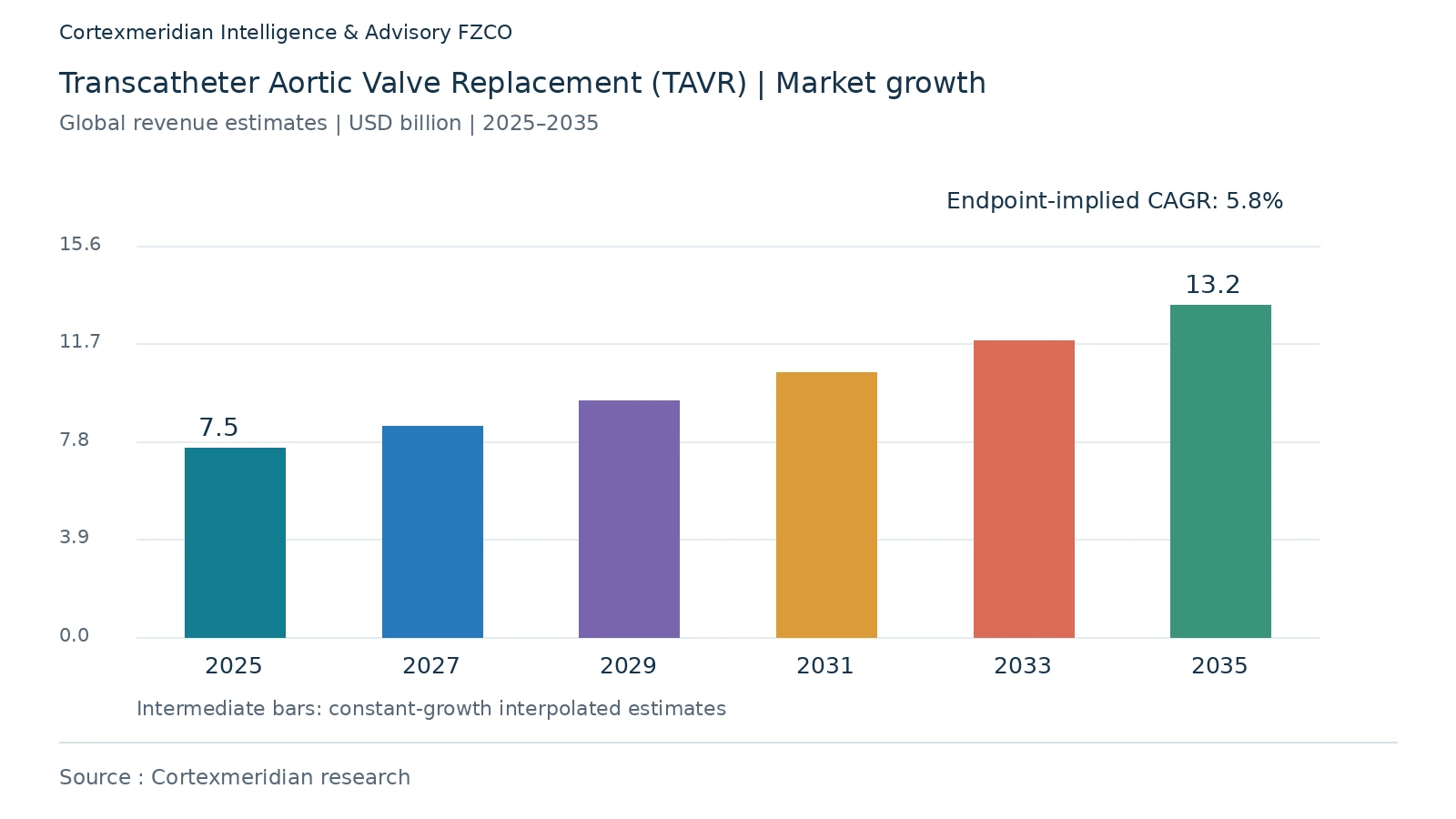
Cortex Meridian Research estimates the TAVR market at approximately USD 7.5 billion in 2025 and expects it to reach around USD 13.2 billion by 2035, representing a CAGR of 5.9%. The category continues to grow because transcatheter therapy is expanding beyond the original high-risk surgical population into lower-risk patients and potentially broader valve-disease indications. Each extension in eligibility materially increases the addressable procedure pool because the device is a high-value implant and treatment is concentrated in specialized structural-heart programs.
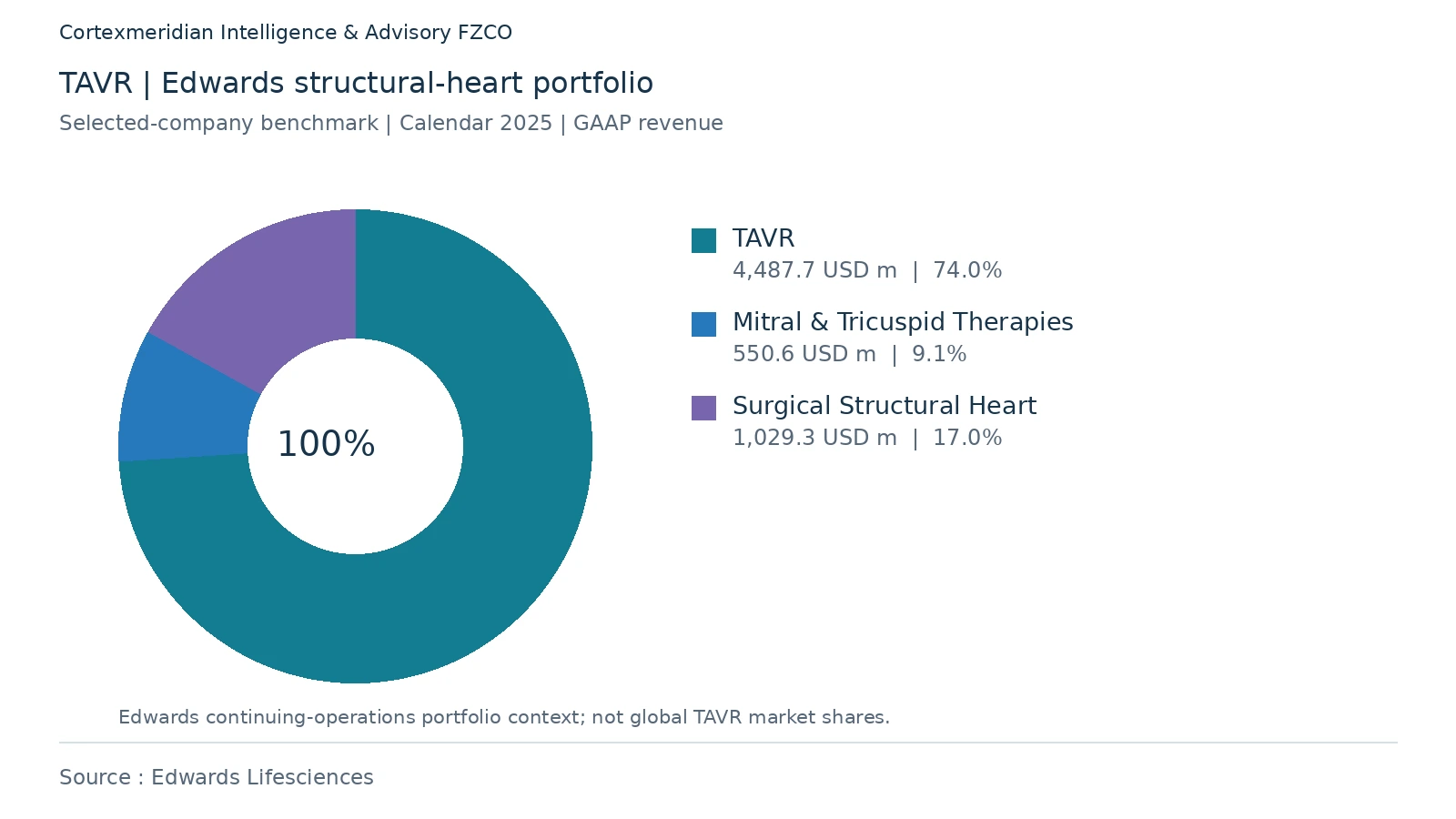
The next competitive frontier is not simply more aortic-stenosis procedures; it is expansion into aortic regurgitation, lifetime valve management and younger patient populations. Edwards Lifesciences and Medtronic remain dominant in conventional TAVR, but the attempted Edwards acquisition of JenaValve shows how strategically important dedicated TAVR-AR technology has become. The FTC’s successful challenge to the transaction preserves an independent competitor and may increase innovation intensity in aortic regurgitation rather than consolidating the segment too early.
The market outlook is therefore shaped by both clinical expansion and competitive breadth. Wider indications support procedure growth, while independent technology development across valve platforms can sustain premium pricing and increase physician choice.
Report Description
The Transcatheter Aortic Valve Replacement (TAVR) Market covers revenue generated from the defined medical-device products, related consumables and software/services where directly attached to the device workflow. The report excludes unrelated pharmaceuticals and stand-alone healthcare services. The scope is designed for manufacturers, suppliers, distributors, hospitals, diagnostic providers, investors and strategy teams evaluating demand, technology shifts, pricing and competitive opportunity.
Overall Market Dynamics
Drivers
Aortic stenosis prevalence, aging populations, expanding indications, minimally invasive preference and improved procedural outcomes.
Restraints / Risks
Premium device pricing, reimbursement/access constraints, procedural complications, competition and stringent clinical evidence requirements.
Opportunities
Lower-risk and younger patient segments, next-generation valve designs, cerebral protection, lifetime management and APAC penetration.
Strategic themes
AI/connectivity, workflow efficiency, reimbursement, regulatory approvals, recurring consumables/service revenue, and regional access expansion.
Segmentation & Scope
By implantation procedure: transfemoral, transapical, transaortic/other; by valve mechanism: balloon-expandable, self-expanding, mechanically expandable; by material; by end user; by patient-risk group; by geography.
Regional & Country Outlook
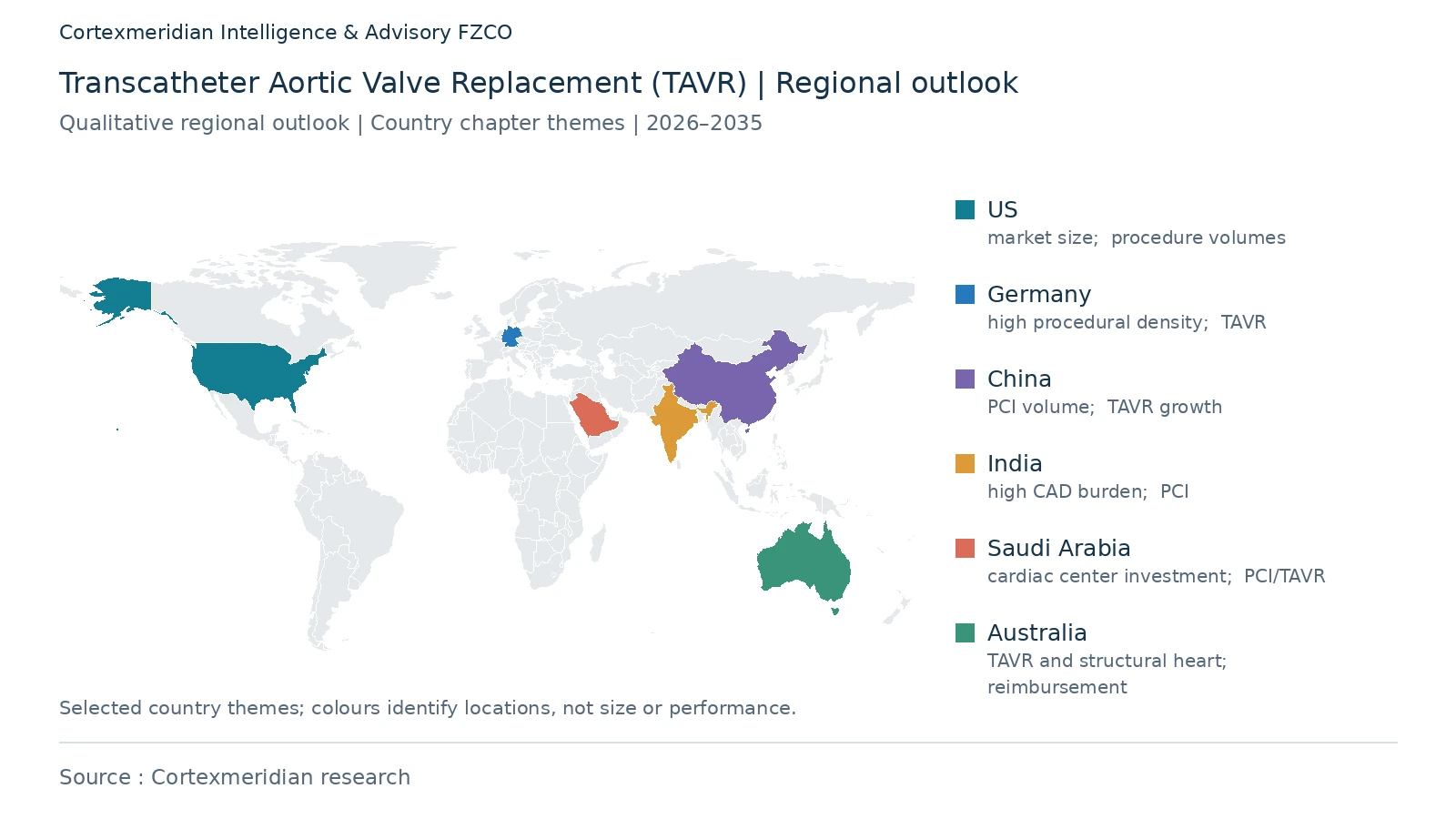
COUNTRY CHAPTER COVERAGE 1. US: market size; procedure volumes; TAVR and structural heart penetration; FDA pipeline; reimbursement; Abbott/Medtronic/Edwards/Boston Scientific competition. 2. Canada: procedure volumes; structural heart; CRM; provincial reimbursement; hospital procurement. 3. UK: NHS cardiology capacity; PCI/TAVR; rhythm management; waiting lists; procurement; reimbursement. 4. Germany: high procedural density; TAVR; EP/CRM; reimbursement; hospital adoption; supplier competition. 5. France: structural heart; interventional cardiology; reimbursement; hospital volumes; device adoption. 6. Italy: TAVR/structural heart demand; regional hospital capacity; reimbursement; procurement. 7. Spain: cardiac procedure volumes; TAVR; public hospital procurement; reimbursement. 8. Netherlands: advanced structural-heart and EP adoption; high-value devices; digital monitoring. 9. Switzerland: premium cardiovascular technologies; private/public hospital mix; structural heart; CRM. 10. China: PCI volume; TAVR growth; local device companies; volume-based procurement; pricing; regulatory approvals. 11. India: high CAD burden; PCI; TAVR growth; price caps; domestic manufacturing; hospital expansion. 12. Japan: aging population; TAVR/CRM; reimbursement; domestic and multinational competition. 13. South Korea: advanced cardiac intervention; TAVR/EP; reimbursement; hospital technology adoption. 14. Australia: TAVR and structural heart; reimbursement; cardiac centers; remote monitoring. 15. Brazil: PCI and rhythm management; public/private access; import pricing; hospital concentration. 16. Argentina: cardiology procedures; import dependency; pricing; reimbursement; private hospitals. 17. Saudi Arabia: cardiac center investment; PCI/TAVR; Vision 2030; tenders; localization. 18. UAE: premium cardiology services; structural heart; private hospitals; technology adoption. 19. South Africa: public/private cardiology split; PCI/CRM access; reimbursement; distribution.
Competitive Landscape & Companies Covered
Edwards Lifesciences; Medtronic; Abbott; Boston Scientific; Meril Life Sciences; JenaValve; Venus Medtech; Peijia Medical
Pricing & Ecosystem
Pricing, Cost & Revenue Intelligence
Pricing intelligence benchmarks capital-system ASPs, disposable/consumable pricing, procedure-linked device pricing, service contracts, software subscriptions and regional tender dynamics where applicable. The model distinguishes capital equipment from recurring revenue and evaluates discounting, bundling, distributor margins, reimbursement sensitivity and premium technology price realization.
Value Chain & Ecosystem Analysis
The ecosystem maps component and sensor suppliers, materials vendors, device OEMs, software/AI partners, contract manufacturers, sterilization and packaging providers, distributors, hospitals/diagnostic laboratories/ASCs, clinicians, payers and regulators. The analysis identifies control points in the value chain, recurring-revenue pools, channel dependencies and partnership opportunities.
Opportunity & White-Space Analysis
A weighted opportunity model scores product segments, technologies, countries, end users and accounts using growth, market size, clinical adoption, reimbursement, competitive intensity, regulatory accessibility and margin potential. Priority white spaces include Lower-risk and younger patient segments, next-generation valve designs, cerebral protection, lifetime management and APAC penetration.
Executive Summary
The TAVR market is estimated at USD 7.5 billion in 2025 and is projected to reach approximately USD 13.2 billion by 2035 at a CAGR of 5.9%. Growth is being driven by broader eligibility, expansion into new valve-disease indications and sustained investment in structural-heart programs.
The blocked Edwards–JenaValve transaction is strategically important because it preserves competition in TAVR for aortic regurgitation, one of the most significant untapped opportunities in the category. Continued rivalry among Edwards, Medtronic and emerging valve specialists should support innovation, broaden treatment options and sustain premium device economics.
Key Takeaways
- 2025 Cortex normalized estimate: USD 7.5 billion
- 2035 normalized outlook: USD 13.2 billion
- Normalized 2025–2035 CAGR: 5.9%
- Key growth drivers: Aortic stenosis prevalence, aging populations, expanding indications, minimally invasive preference and improved procedural outcomes.
- Priority opportunity areas: Lower-risk and younger patient segments, next-generation valve designs, cerebral protection, lifetime management and APAC penetration.
- Primary competitive set: Edwards Lifesciences; Medtronic; Abbott; Boston Scientific; Meril Life Sciences; JenaValve; Venus Medtech; Peijia Medical
Table of Contents
List of Tables
- Global market value, 2021–2035
- Market by product/device type
- Market by technology
- Market by application/procedure
- Market by end user
- Market by region
- Country market sizing
- Installed base/procedure/test indicators
- ASP/pricing benchmark
- Company/product benchmark
- Opportunity attractiveness scoring
List of Figures
- Market size and CAGR outlook
- Segment attractiveness matrix
- Technology adoption curve
- Regional opportunity heat map
- Competitive positioning matrix
- Value-chain ecosystem map
- Pricing/revenue model
- Opportunity prioritization matrix
Research Methodology
Methodology
Cortex Meridian Research applies a triangulated market-sizing framework combining company disclosures, regulatory databases, procedure/test volumes, installed-base indicators, shipment and utilization data, hospital and laboratory purchasing patterns, reimbursement signals, product approvals, and primary research. Public market benchmarks are used only as external calibration points; Cortex values are normalized to the defined scope and forecast period. Forecasts consider technology adoption, procedure/test growth, replacement cycles, pricing, reimbursement, regulatory changes, and regional healthcare investment.
Data Sources & Validation
Company annual reports and investor materials; FDA, EMA and other regulatory databases; WHO and national health agencies; peer-reviewed clinical literature; procurement and reimbursement sources; hospital/laboratory statistics; trade and shipment indicators; company product portfolios; primary interviews; and public market benchmarks used for calibration.
FAQ — Buyer Questions
Q: What is the 2025 global Transcatheter Aortic Valve Replacement (TAVR) market size? A: Cortex Meridian Research estimates it at approximately USD 7.5 billion.
Q: What is the 2035 market outlook? A: The normalized outlook is approximately USD 13.2 billion, based on a 5.9% CAGR assumption.
Q: What are the major growth drivers? A: Aortic stenosis prevalence, aging populations, expanding indications, minimally invasive preference and improved procedural outcomes.
Q: Which opportunities should suppliers prioritize? A: Lower-risk and younger patient segments, next-generation valve designs, cerebral protection, lifetime management and APAC penetration.
Customization Options
Customization can include country-level sizing, procedure/test volumes, installed base, ASP benchmarking, hospital/lab account mapping, competitor benchmarking, product pipeline analysis, regulatory and reimbursement tracking, KOL mapping, distributor/channel assessment, and opportunity prioritization.
Need something this report does not cover?
Describe the decision you are facing. If a published study already answers it we will point you there; if not, we will scope the work and come back with timeline and cost.
CM-MD-0008 · CM-MD-P1-1008 · 180-220 pages · Published October 2026 · Cortex Meridian Medical Devices Analyst Team